

Factors affecting the offline size in the wire harness process
Jan 12, 2024
Several Factors affect the Wire Harness Length.
The process calculation of wire length directly affects the progress of processing and the performance of the wire harness. During processing, both long and short wires can occur. If the wire is too short, it will not meet the drawing and loading requirements, requiring processing personnel to lengthen or replace the wire, which is time-consuming and labor-intensive. If the wire is too long, it can be difficult to organize and may bulge during the wire harness processing and finishing stages, resulting in poor appearance and assembly. Eddy currents can form behind the car, which may generate heat and shorten the service life of the wiring harness. Therefore, the correct wire length is crucial to the wire harness process. The following will briefly discuss the factors that affect the wire length in the wire harness process from several aspects.
1. OEM Measuring Point
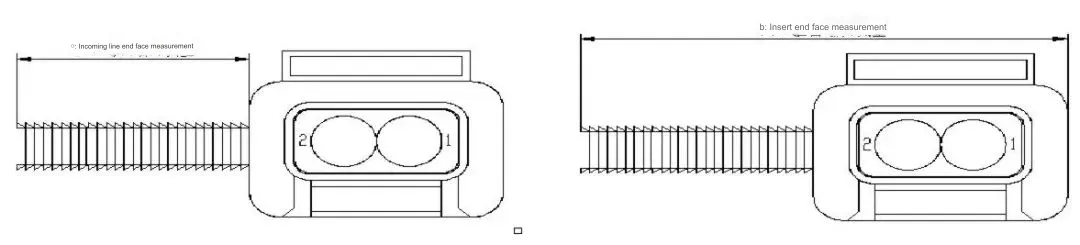
Wiring harness drawings and special wiring harness products (such as high-voltage lines) from different OEMs have different definitions for branch measurement points, as shown in Figure 1:
a. Some require measurement from the end face of the connector's incoming end.
b. Others require measurement from the end of the connector's insertion end.
Both measurement methods can result in the same length. However, whether the size of the connector is included in the branch measurement can cause a difference in the length of the wire harness. Different definitions of measuring points directly affect the length of the branch. When calculating the length for the process, it is necessary to fully understand the measuring points on the design drawings.
Figure 1
Schematic diagram of wire harness insertion measurement under different methods
2. Dimensions of the Plug Connector
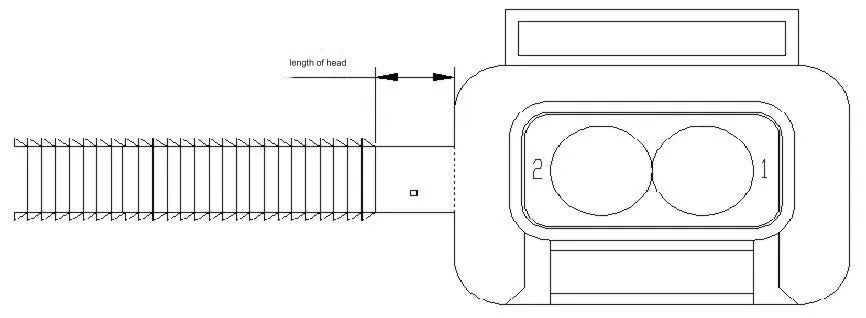
The protruding size is commonly found in wire harness drawings (see Figure 2), and different design drawings define it differently:
- The size of the outlet can be considered as the loss of the internal plug wire within the sheath, and this length is not included in the branch length.
- The protruding length is the buffer size between the wrapping material and the connector, and the branch length includes this protruding length.
- If a tail clip is used, it is placed between the connector and the wrapping material. The protruding length is considered as the internal loss of the tail clip and the connector.
In summary, whether the outlet size represents the internal loss of the connector and tail clip directly affects the branch length. Generally, for connectors with 8 holes or fewer, the lost wire length when equipped with a tail clip does not exceed 5 cm. When the protruding length is less than 5 cm, it is regarded as internal loss of the connector, and there is no need to increase the branch length.
Figure 2
Dimensions of plug connector
3. Wire, Wire Diameter, and Length
Wires should not be taut when assembled into wire harness products. The stress on a single wire should be natural, without stretching or folding. Therefore, the length calculated solely from the drawings does not meet the needs of actual processing and should be lengthened appropriately. In addition, most wire harness processing at this stage is done manually, and length loss is inevitable. Therefore, an appropriate margin should be added to the length based on the drawing.
The increased margin is closely related to the wire's length, material, and diameter. Generally, the longer the length, the greater the loss and the larger the lengthening margin. The larger the wire diameter, the less likely it is to bend in the wire harness, leading to smaller loss and a smaller margin. Different wire materials, such as shielded wires, camera wires, and ABS wires, have larger diameters than ordinary wires, and thus, they tend to have less loss and smaller margins. Because different electrical devices have varying functions and load currents, different wire materials and diameters need to be selected, which results in varying wire lengthening margins. Therefore, a properly-sized wire harness needs to go through several margin optimizations and accumulated experience.
4. The Outlet Direction of the Connector
Among the wiring harness connectors, there is a special connector that allows wires to exit from both the left and right sides (see Figure 3). Because the connector is larger, when the wires exit from the left side, the length of the wires near the pins on the left side is equivalent to the length of the connector compared to the length of the pins on the right side, and vice versa. Therefore, it is necessary to determine the outlet direction of the connector based on the loading conditions and requirements in order to address such issues.
Figure 3
The outlet direction of the connector

5. Wrapping Materials
Wire harness wrapping materials generally include corrugated pipes, PVC pipes, nylon sleeves, and tape wrapping. Different wire harness products require different wrapping materials depending on the installation location and the sales area.
- Pipes (e.g., corrugated pipes): Corrugated pipes can be classified as closed or open pipes based on processing requirements. Closed pipes pose challenges when there are many main wires, as they are difficult to penetrate and process. Furthermore, wires inside closed pipes tend to tangle, leading to more length loss compared to open pipes. As a result, more allowance should be provided for closed pipes.
- Tape Wrapping: Tape wrapping can be divided into dense wrapping, point wrapping, and flower wrapping. Dense wrapping, where the wire is more tightly wound, results in greater length loss compared to point wrapping or flower wrapping. Therefore, additional margin should be added in cases of dense wrapping. It is clear that different wrapping materials also have varying requirements for length.
6. Branch Manifold and Trunking
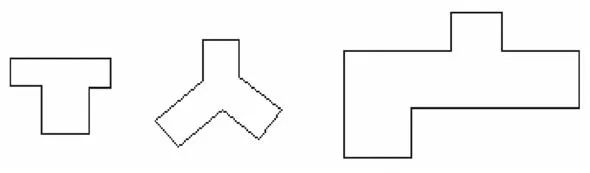
Branch manifolds and wire troughs are located at the branch points and are used to fix the direction of the wire harness branches (see Figure 4). When using them, it is important to match the appropriate pipe material according to the hole diameter and clamp the corrugated pipe to fix the direction. There is length loss inside branch manifolds and wire troughs, so margin settings should also be considered when using these components.
Figure 4
Branch manifold and wire trough schematic diagram
7. Connector and Tail Clip Allowance
The connector is the central component that connects wires to electrical appliances. It plays a crucial role in the functionality of the wire harness and is also the most expensive raw material in the wire harness. Understanding the connectors used is vital to the craftsmanship of the wire harness. After the wire is crimped to the terminal and inserted into the connector, part of the length is lost inside the connector. Additionally, the tail clip on the connector increases the length loss. Therefore, the rationality of the margin setting significantly impacts the total length of the wire harness. Importantly, when calculating the process length, it is essential to first understand the wire length loss due to the connector and tail clip, and include this in the offline size.
8. Wires to Participate in Check-In
In wire harness processing, there are situations where multiple wires need to be connected. Conductor crimping and ultrasonic welding are commonly used methods to connect the wires. As shown in Figure 5, the length of the welding area and conductor crimping area is approximately 2 cm. This length loss should be taken into account when calculating the size of the lower wire. This is especially important when multiple connections are involved, as the impact on the wire length becomes more significant.
Figure 5
Wiring harness conduction diagram

9. Wire Routing within the Harness
The wires in the wiring harness can run in different directions. The simplest routing involves running the wire in a straight line without any bends, which results in minimal length loss. However, the more bends the wire has, the more length is consumed in the bends, increasing the overall length of the wire. Additional allowance should be added to these wires to ensure a smooth transition at the bends.
10. Conclusion
With the development of automotive technology and the advent of intelligent manufacturing, the functions of automobiles are becoming increasingly diverse. The wire harness serves as the communication bridge between various electrical components. As automotive technology continues to evolve, the composition of wire harnesses will become more complex, and new requirements for wires will continue to emerge. Wire harness craftsmen must analyze and calculate wire lengths based on various factors, making the process more challenging. This article focuses on the fundamental issue of wire length in wire harnesses and briefly analyzes the factors that affect wire length during the harnessing process to ensure its accuracy.
